Businesses increasingly rely on mobile technology to connect with customers, streamline operations, and create more convenient digital experiences. The benefits of mobile App development for businesses extend beyond simply having an app in an app store. A well-planned mobile application can support customer engagement, business automation, data collection, productivity, and long-term growth.
However, the results depend on choosing the right features, technology, security standards, and development approach. For business owners and IT managers in the United States, understanding the practical value of mobile app development can help determine whether a custom app is a worthwhile investment.
Why Mobile App Development Matters for Business Growth
A mobile app gives businesses a direct channel to serve customers, streamline processes, and control their digital experience. Its value depends on the business model, whether the goal is mobile shopping, bookings, customer communication, or workflow automation.
Key benefits include:
- Better customer engagement and convenience
- Process automation and improved efficiency
- Stronger retention opportunities
- Useful data and analytics
- Greater scalability and control
The best app solves a genuine customer or business need rather than simply following a trend.
-
Improved Customer Engagement
One of the major benefits of mobile App development for businesses is the ability to create a direct and convenient customer communication channel.
Businesses can use mobile applications to provide features such as:
- Personalized user experiences
- In-app messaging
- Account management
- Loyalty programs
- Product or service updates
- Notifications based on user activity
A well-designed app can reduce friction between customers and a business. However, engagement depends on providing genuine value. Excessive notifications, confusing navigation, or unnecessary features can cause users to stop using an application.
-
Better Customer Experience and Convenience
Customers increasingly expect digital services to be simple and accessible. A mobile application can bring frequently used services into one centralized platform.
For example, an app may allow users to:
- Book appointments
- Place orders
- Track deliveries
- Request support
- Manage accounts
- Make payments through supported integrations
The specific features should be based on customer needs and business objectives. A simpler application with a clear user journey is often more effective than an app overloaded with features that users rarely need.
-
Business Process Automation
Mobile apps can reduce repetitive manual tasks by automating workflows such as customer requests, bookings, order updates, approvals, and service management.
Instead of handling every request through calls or emails, customers can submit information directly through the app. This helps organize workflows and reduce administrative work.
For effective automation, the app should integrate properly with existing systems such as CRM, ERP, payment, inventory, and customer support platforms.
-
Better Customer Retention and Loyalty
A mobile app can support ongoing customer relationships by making repeat interactions easier.
Businesses may use features such as:
- Loyalty rewards
- Personalized offers
- Saved preferences
- Purchase history
- Membership benefits
- Customer accounts
However, an app alone does not guarantee customer loyalty. Retention usually depends on the overall customer experience, product or service quality, pricing, support, and the usefulness of the application.
-
Access to Business Data and Analytics
Mobile applications can generate useful information about how customers interact with digital services. Depending on the application and privacy requirements, businesses may analyze user behavior, feature usage, conversions, and customer journeys.
This information can help businesses make more informed decisions about:
- Which features customers use most
- Where users leave a process
- Which services receive more engagement
- How customers interact with offers
- Which parts of the app require improvement
Data should be collected responsibly and managed according to applicable privacy and security requirements.
-
Greater Business Scalability
A scalable mobile application can support business growth as the number of users, transactions, and features increases. Scalability should be considered during the planning stage rather than treated as an afterthought.
Technical planning may include:
- Scalable backend architecture
- Cloud infrastructure
- API design
- Database performance
- Efficient application code
- Monitoring and maintenance
A business should also consider future requirements before development begins. Rebuilding an application later because the original architecture cannot support growth can increase both cost and development time.
-
Customization for Specific Business Needs
Custom app development lets businesses build features around their actual processes instead of adapting to generic software.
A Custom App Development Agency can create solutions with custom dashboards, customer portals, payment integrations, booking systems, inventory tools, and other business features.
Although custom development may cost more initially, businesses should evaluate long-term value, scalability, operational needs, and expected outcomes—not just the upfront price.
Android and Cross-Platform Development Considerations
Businesses should select a development approach based on their target users, budget, timeline, and technical requirements.
Android App Development
Android applications help businesses reach users across a wide range of devices and markets. This development approach can be a suitable choice when a business’s target audience includes a significant number of Android users.
Cross-Platform Development
Cross-platform development can allow businesses to build applications for multiple platforms using a shared development approach. This may help reduce duplicated development work, although the right choice depends on application complexity, performance requirements, device features, and long-term maintenance needs.
The best technology is not always the most popular one. It should support the actual requirements of the project.
Technical Requirements Businesses Should Consider
Before starting mobile app development, businesses should define the technical and commercial requirements clearly.
Important considerations include:
Performance
Applications should load efficiently and respond reliably. Poor performance can negatively affect user experience and increase abandonment.
Security
Security should be considered throughout development. Authentication, authorization, secure data handling, API security, and appropriate testing are important considerations for applications handling sensitive information.
Integration
Many business applications need to connect with existing systems. Development teams should assess API availability, data synchronization, authentication, and integration complexity before development begins.
Maintenance
Mobile app development does not end at launch. Operating system updates, security improvements, bug fixes, performance monitoring, and feature updates may be required over time.
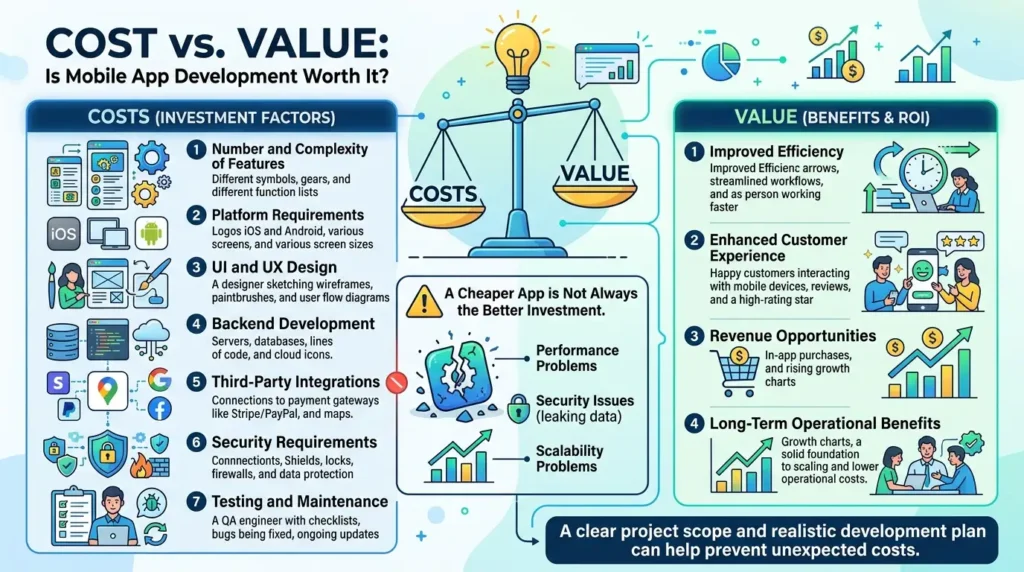
Cost vs Value: Is Mobile App Development Worth It?
The cost of an app depends on factors such as:
- Number and complexity of features
- Platform requirements
- UI and UX design
- Backend development
- Third-party integrations
- Security requirements
- Testing and maintenance
A cheaper app is not always the better investment if it creates performance, security, or scalability problems. Businesses should evaluate the expected value of the application, including improved efficiency, customer experience, revenue opportunities, and long-term operational benefits.
A clear project scope and realistic development plan can help prevent unexpected costs.
Common Mobile App Development Mistakes
Businesses can avoid many problems by planning carefully before development begins.
Common mistakes include:
- Building an app without a clearly defined business objective
- Adding too many features to the first version
- Ignoring user experience
- Underestimating security requirements
- Failing to plan for scalability
- Not testing on relevant devices
- Ignoring ongoing maintenance
- Choosing technology based only on development cost
A focused Minimum Viable Product can help businesses validate the core idea before investing in more advanced features.
How Feynix Solution Supports Mobile App Development
Feynix Solution helps U.S. businesses develop practical mobile apps aligned with their goals. From planning and UI/UX design to backend development, integrations, security, testing, and ongoing support, the team focuses on building scalable solutions that improve customer access and business efficiency.
The right development approach depends on the specific business model, target users, technical requirements, and long-term growth plans.
Customer Testimonials
The team helped us create a practical mobile solution focused on the features our customers actually needed.
— Business Owner
Their planning helped us understand scalability and long-term app maintenance.
— IT Manager
A custom mobile app fit our workflow better than a generic solution.
— Business Client
FAQs
What are the main benefits of mobile app development for businesses?
Mobile apps can improve customer engagement, automate processes, support retention, provide data insights, and help businesses scale.
Is mobile app development worth it for a small business?
Yes, if the app solves a genuine customer or operational need and provides measurable long-term business value.
How much does it cost to develop a business mobile app?
The cost depends on features, platforms, design, integrations, backend requirements, security, and ongoing maintenance.
Should a business build an Android app or a cross-platform app?
The right choice depends on your target users, app complexity, performance needs, budget, and long-term development goals.
Conclusion
The Benefits of Mobile App Development for Businesses include improved customer engagement, automation, data insights, and scalable growth. Businesses should define clear goals, understand user needs, and plan for security, scalability, and long-term value.
Feynix Solution helps U.S. businesses develop practical mobile app solutions aligned with their growth objectives.
Feynix Solution provides mobile app development services to businesses worldwide, including the U.S., Pakistan, and other international markets. Give us the opportunity to work with you, and our team will deliver reliable solutions tailored to your business needs.
Talk To Us
Facebook
Instagram
Linkedin
Pinterest
About Us
The Feynix Solution content team creates practical content on mobile app development, IT services, software solutions, and digital transformation to help businesses make informed technology decisions.