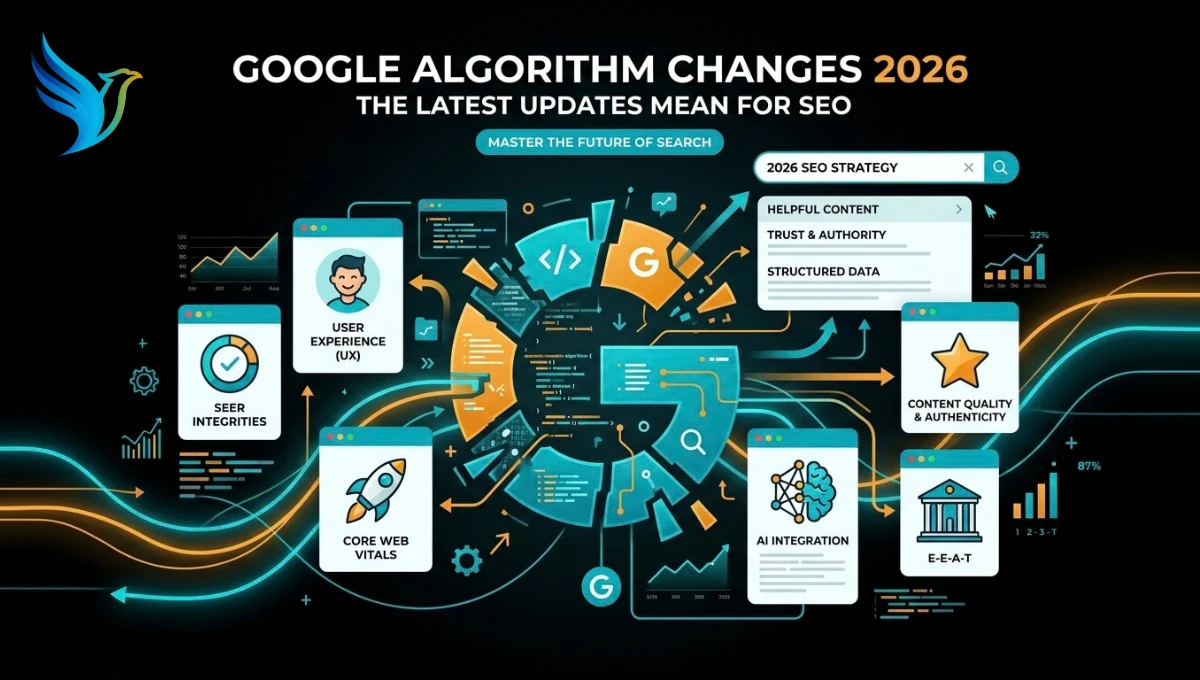
Google algorithm changes continue to shape how websites appear in search results, and 2026 has brought important developments for website owners, marketers and SEO professionals. As of October 2026, Google is rolling out its September 2026 Spam Update, while Google has also introduced new reporting for web multimodal search in Search Console. These changes show that SEO is moving beyond traditional text-based searches and increasingly includes visual, AI-assisted and multimodal experiences.
For businesses, this means SEO should not focus only on keywords and rankings. Instead, websites need useful content, strong technical foundations, trustworthy information, high-quality visuals and a search strategy that can adapt to how people use Google today. Feynix Solution helps businesses build and optimise websites with SEO strategies that also consider GEO, AEO and DEO, helping brands prepare for the changing search landscape.
What Are the Latest Google Algorithm Changes?
Google regularly improves its search systems to better understand queries, content and user intent. However, it is important to distinguish between a confirmed ranking update, a new search feature and ongoing changes to Google’s ranking systems.
The most recent confirmed ranking update is the September 2026 Spam Update. Google announced that it began on September 24, 2026, applies globally and affects all languages. Google says the rollout may take up to two weeks, and the Search Status Dashboard still lists it as active as of October 1, 2026.
This is important because the September update is a spam update, not a confirmed broad core update. Therefore, businesses should not automatically assume that every ranking fluctuation during this period is caused by a new core algorithm.
Google’s confirmed 2026 ranking history also includes the March 2026 Core Update, May 2026 Core Update, and several spam updates. The May core update ran for almost 12 days, while Google’s September spam update is taking a longer rollout period.
Google September 2026 Spam Update
The September 2026 Spam Update is one of the most important current google search algorithm changes for website owners to monitor.
According to Google’s Search Status Dashboard, the update:
- Started on September 24, 2026
- Applies globally
- Applies to all languages
- Impacts Google Search ranking
- May take up to two weeks to complete
Google has not announced a new individual spam technique that this particular update targets. Instead, Google describes it as a spam update. Its broader spam policies cover practices designed to manipulate Search or improve visibility through deceptive methods. Websites that violate these policies can rank lower or be omitted from Search.
Therefore, businesses should use this rollout as an opportunity to review their websites rather than react to every daily ranking movement.
What Should Websites Check During the Update?
First, review pages that have experienced significant changes in impressions, clicks or rankings.
Next, check whether the website contains:
- Thin or low-value content
- Automatically generated pages with little original value
- Keyword-stuffed content
- Hidden text or links
- Manipulative redirects
- Unnatural or deceptive content
- Large numbers of unoriginal pages
- Spammy third-party content
- Pages created primarily to manipulate search rankings
Google specifically states that scaled content abuse can involve producing many pages primarily to manipulate rankings, including AI-generated content when it provides little or no additional value.
This does not mean that using AI automatically violates Google’s policies. The important issue is whether the resulting content provides genuine value and is created for people rather than simply for search engines.
Google’s New Multimodal Search Change
Another important development is Google’s September 2026 announcement about web multimodal Search performance reporting in Search Console.
On September 24, Google announced a new Search Console reporting option that helps site owners understand how their content performs when people search using images and other multimodal methods.
The new reporting includes data from:
- Google Lens
- Circle to Search on Android
- Image uploads to Google Search
- Chrome’s “Search this image” feature
Google says the new multimodal search data is being rolled out globally. Website owners can access it through a new multimodal search type filter in Search Console performance reports.
This development is especially relevant for ecommerce businesses, product companies, restaurants, real estate websites, fashion brands and other businesses where images communicate important information.
Is Multimodal Search a New Google SEO Algorithm?
Not exactly.
The September announcement is primarily about new Search Console performance reporting, rather than Google announcing a new ranking algorithm.
However, it demonstrates an important direction for Search: people are increasingly able to search using combinations of text, images and other forms of input.
That means businesses should think about visual SEO alongside traditional text SEO.
For example, an ecommerce company should not only optimise a product page’s written content. It should also make sure product images are descriptive, relevant, technically accessible and supported by appropriate page content and structured data where applicable.
Google’s Search documentation also highlights image optimisation and structured data as ways to help Google understand different types of website content.
What Do These Google Search Algorithm Changes Mean for SEO?
The biggest lesson from the latest google latest algorithm updates is that SEO is becoming broader.
Traditional SEO still matters. However, businesses now need to consider how their content can appear across different search experiences.
- Focus on People-First Content
Google continues to emphasise helpful, reliable and people-first content.
Its guidance recommends creating content primarily for users rather than producing content simply to gain search traffic. Google also recommends evaluating whether content demonstrates first-hand expertise, provides useful information and leaves visitors satisfied.
So, instead of asking:
“How many keywords should we put on this page?”
businesses should ask:
“Does this page genuinely answer the customer’s question?”
Keywords still have a role. Google recommends using words people would search for in prominent areas such as titles, headings, alt text and link text. However, this should be done naturally and within useful content.
- Don’t Chase Every Google Update
Every ranking change does not require a website redesign.
During a confirmed rollout, rankings can fluctuate. Therefore, businesses should compare performance over an appropriate period and identify meaningful patterns rather than reacting to one or two days of data.
Google itself recommends examining which pages and search types were most affected when analysing ranking drops.
A sensible SEO process includes monitoring:
- Organic clicks
- Impressions
- CTR
- Average position
- Indexed pages
- Search queries
- Landing pages
- Technical errors
- Conversion performance
This provides a much clearer picture than looking at rankings alone.
The Role of Technical SEO After a Google Update
Content is only one part of SEO.
A website should also have a strong technical foundation so Google can discover, crawl and understand its pages.
Important areas include:
Indexing: Make sure important pages are indexable and that unwanted pages are appropriately controlled.
Internal linking: Create clear connections between related pages so users and search engines can discover important content.
Canonical URLs: Use canonicalisation correctly where duplicate or similar URLs exist.
XML sitemap: Keep the sitemap clean and include important canonical URLs.
Robots.txt: Make sure crawling isn’t accidentally blocked for important resources or pages.
Page experience: Ensure the website works properly across devices and provides a good overall experience.
Structured data: Where relevant, use supported structured data to help Google understand the content.
Google’s Search Essentials identifies technical requirements, spam policies and key best practices as important parts of making web content eligible to perform in Search.
How SEO Is Changing With GEO, AEO and DEO
At Feynix Solution, we don’t view modern SEO as simply placing keywords on pages.
Search behaviour is changing, so businesses need content that can work across different discovery environments.
SEO — Search Engine Optimisation
Traditional SEO focuses on helping websites become more visible in search engines.
This includes:
- Keyword research
- On-page optimisation
- Technical SEO
- Content optimisation
- Internal linking
- Image optimisation
- Schema and structured data
- Search Console monitoring
- Analytics
- Local SEO
- Website performance
The objective is to make a website easier for search engines to discover, understand and serve to relevant users.
AEO — Answer Engine Optimisation
AEO focuses on making content useful for questions and answer-based search experiences.
Instead of only targeting:
“SEO services Pakistan”
a business may also create useful content answering questions such as:
“How does SEO help a small business?”
or:
“How long does SEO take to improve website visibility?”
Clear headings, direct answers, useful explanations and well-structured content can make pages easier for both users and search systems to understand.
GEO — Generative Engine Optimisation
GEO focuses on improving how a brand’s information can be understood and surfaced in generative AI search experiences.
This makes clear, authoritative and well-supported information increasingly important.
A business should make its:
- Services
- Products
- Expertise
- Locations
- Brand information
- Authors
- Supporting content
easy to understand and consistent across its digital presence.
DEO — Digital Experience Optimisation
DEO focuses on the wider digital experience.
Getting someone to a website is only the first step. The website also needs to help visitors understand the business, find information, trust the brand and take the next step.
This includes:
- Website usability
- Navigation
- Mobile experience
- Content clarity
- Conversion paths
- Page speed
- Calls to action
- Visual presentation
- Trust signals
Together, SEO, AEO, GEO and DEO create a more complete search and digital strategy.
What Businesses Should Do During the Latest Google Update
If your rankings or traffic have changed during the September 2026 rollout, don’t immediately remove pages or rewrite your entire website.
Instead, follow a structured process.
First, check Google Search Console. Look for changes in impressions, clicks, CTR, average position and affected queries.
Second, check Google Analytics. Determine whether the change is affecting organic users, engagement or conversions.
Third, identify affected pages. A site-wide change and a drop limited to a few URLs require different investigations.
Fourth, review content quality. Check whether pages provide original, useful information and satisfy the visitor’s intent.
Fifth, check technical SEO. Review indexing, canonical tags, sitemap status, robots.txt, redirects and important page errors.
Finally, monitor the update until Google’s rollout is complete. Since the September 2026 Spam Update is still listed as active, making major changes based solely on incomplete rollout data can make diagnosis more difficult.
How Feynix Solution Can Help With Modern SEO
At Feynix Solution, we provide website and digital solutions that include SEO as part of a broader digital growth strategy.
Our SEO work can cover technical SEO, on-page optimisation, content strategy, keyword research, website structure, internal linking, search performance monitoring and optimisation based on Search Console and Analytics data.
We also work with GEO, AEO and DEO to help businesses prepare for the changing ways people discover information online.
That means we don’t only look at whether a page contains a target keyword. We also consider whether the page is useful, technically accessible, easy to understand, structured clearly and aligned with the user’s search intent.
As Google continues developing traditional, visual, multimodal and AI-powered search experiences, businesses need a website that can adapt with those changes.
Final Thoughts
The latest Google algorithm for SEO should not be viewed as a single change that completely rewrites the rules of search. Google operates many ranking systems and regularly introduces updates, new search experiences and reporting changes.
Right now, the confirmed September 2026 Spam Update is still rolling out globally, while Google’s new multimodal Search Console reporting is giving site owners more insight into traffic generated through image-based searches.
The practical response is clear: build useful content, maintain strong technical SEO, avoid manipulative practices, optimise visual content and monitor real performance data.
Businesses that combine SEO with AEO, GEO and DEO can build a more complete digital search strategy instead of relying on one ranking signal or one type of search result.
For businesses looking to adapt their websites to the latest Google algorithm updates, Feynix Solution can help with website SEO, content optimisation, technical improvements and broader search-focused digital strategies.
Author Bio
The Feynix Solution Team provides website development, digital solutions and SEO services for businesses looking to improve their online presence. The team works across SEO, AEO, GEO and DEO, combining technical optimisation, useful content and digital experience improvements to help businesses build stronger, search-ready websites.