
Logistics and transportation companies increasingly rely on web application development services in Karachi to manage fleet coordination, shipment tracking, driver management, and delivery scheduling.
Custom web applications connect these workflows in one centralized system, helping businesses improve visibility, automate repetitive tasks, manage data efficiently, and deliver better experiences for customers, drivers, and internal teams.
Why Logistics Companies Need Custom Web Applications
A logistics business often depends on multiple processes working together. Transportation management, warehouse operations, delivery tracking, invoicing, customer service, and reporting may all require different tools.
A custom web application can bring these functions into one platform based on the specific needs of the business.
Common benefits include:
- Centralized operational data
- Real-time shipment and delivery visibility
- Better fleet and driver management
- Automated workflows and notifications
- Improved communication between departments
- Customer self-service portals
- Easier reporting and performance monitoring
Unlike generic software, a custom application can be designed around a company’s existing processes and future requirements.
Key Features of a Logistics Web Application
The features required will depend on the company’s size, services, and operational model. However, several capabilities are commonly important for logistics and transportation businesses.
Shipment and Order Management
A web application can help businesses manage shipment details, order status, delivery schedules, and customer information from one central dashboard.
Authorized users can view relevant information based on their roles, reducing the need to search through multiple systems or manually update spreadsheets.
Fleet Management
Fleet management functionality can help businesses organize information about vehicles, drivers, maintenance schedules, and transportation assignments.
A system may support:
- Vehicle records
- Driver assignments
- Maintenance tracking
- Route planning integrations
- Fuel and operational records
- Vehicle availability status
The exact functionality should be based on the company’s operational requirements.
Delivery and Shipment Tracking
Customers increasingly expect visibility into their deliveries. A web application can connect with tracking systems or third-party APIs to provide shipment updates.
Depending on the application architecture, businesses may provide status updates such as:
- Order received
- Shipment processed
- In transit
- Out for delivery
- Delivered
This can reduce the need for customers to contact support for basic shipment updates.
Customer and Vendor Portals
A customer portal can allow users to view orders, track shipments, download documents, and communicate with the business.
Similarly, vendor or partner portals can help manage information shared between logistics companies, suppliers, carriers, and other business partners.
Automated Notifications
Notifications can help keep users informed about important events. These may include updates related to shipment status, delivery schedules, delays, or account activity.
Depending on the business model, notifications may be delivered through email, SMS, or in-application alerts.
How Web Application Development Services in Karachi Support Logistics Businesses
Choosing web application development services in Karachi can help businesses work with a development team that understands local business operations while building solutions for regional or international markets.
For logistics companies, the development process should go beyond simply creating a website. A professional development team should understand the operational workflow, identify technical requirements, plan the application architecture, and consider future scalability.
The process may include:
- Business and workflow analysis
- Functional requirement planning
- UI/UX design
- Technology and architecture selection
- Application development
- API and third-party integrations
- Testing and quality assurance
- Deployment
- Ongoing maintenance and improvements
This structured approach can help reduce technical problems and ensure that the final application supports actual business operations.
Important Integrations for Transportation Applications
Logistics applications often need to communicate with other systems. Integrations can reduce manual data entry and improve the flow of information between platforms.
Depending on the project, a web application may integrate with:
- GPS and mapping services
- Payment gateways
- Accounting software
- Customer relationship management systems
- Enterprise resource planning platforms
- SMS and email services
- Warehouse management systems
- Third-party shipping APIs
The required integrations should be planned during the early stages of development. Adding complex integrations later may require additional development work and architectural changes.
Scalability and Performance Considerations
A logistics application may start with a limited number of users but grow over time. As the business expands, the system may need to handle more orders, users, locations, vehicles, and data.
Scalability should therefore be considered from the beginning.
Important technical considerations may include:
- Efficient database architecture
- Optimized API performance
- Secure cloud infrastructure
- Caching where appropriate
- Modular application architecture
- Load testing for important workflows
A scalable system does not necessarily mean building every advanced feature from the beginning. A better approach is often to create a strong foundation that can support future development.
Security Requirements for Logistics Web Applications
Logistics applications may store sensitive business information, customer details, delivery data, financial information, and employee records.
Security should be treated as a core development requirement rather than an optional feature.
Important security practices may include:
- Secure user authentication
- Role-based access control
- Encrypted data transmission
- Secure API development
- Regular security testing
- Proper database protection
- Backup and recovery planning
The specific security requirements will depend on the application’s data, users, integrations, and industry obligations.
Custom Web Application vs. Ready-Made Software
Many logistics companies consider whether to purchase an existing platform or build a custom application.
Ready-Made Software
A ready-made solution may be suitable when:
- The business has standard operational requirements
- The available features match existing workflows
- Quick implementation is important
- Customization needs are limited
Custom Web Application
Custom development may be more suitable when:
- The business has unique operational processes
- Multiple systems need to be integrated
- The company requires specialized workflows
- Existing software creates operational limitations
- The application needs to support future expansion
The right decision depends on the business requirements, budget, internal resources, and long-term technology strategy.
Cost and Timeline Considerations
The cost of developing a logistics web application depends on the complexity of the project.
Factors that can affect development cost include:
- Number of features
- User roles and permissions
- UI/UX requirements
- Third-party integrations
- Real-time tracking requirements
- Backend architecture
- Security requirements
- Testing and maintenance needs
A basic internal application will generally require a different development approach than a large platform serving multiple customers, carriers, and locations.
Instead of focusing only on the initial development price, IT managers should also consider the long-term value of the application, including maintenance, scalability, operational efficiency, and future development requirements.
Common Mistakes to Avoid
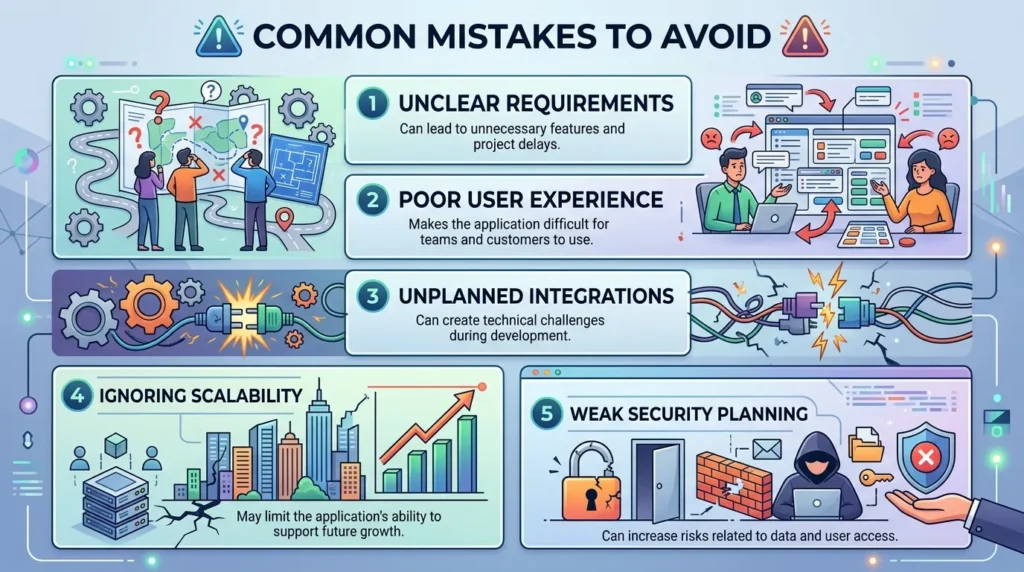
- Unclear Requirements: Can lead to unnecessary features and project delays.
- Poor User Experience: Makes the application difficult for teams and customers to use.
- Unplanned Integrations: Can create technical challenges during development.
- Ignoring Scalability: May limit the application’s ability to support future growth.
- Weak Security Planning: Can increase risks related to data and user access.
How Feynix Solution Can Help Logistics Businesses
Feynix Solution helps logistics and transportation companies develop custom web applications based on their operational needs. From workflow analysis and UI/UX design to backend development, API integrations, testing, and deployment, the team supports the complete development process.
Solutions may include customer portals, shipment tracking systems, fleet management platforms, and internal dashboards. When mobile access is required, businesses can also explore custom app development, Android app development, and iOS application development.
Customer Testimonials
A well-planned web application can make it easier for logistics teams to manage information and reduce dependency on disconnected systems.
For transportation businesses, having the right digital workflow is important for improving visibility across orders, deliveries, and internal operations.
Custom development is valuable when standard software does not fully match the way a logistics company operates.
FAQs
What is web application development for logistics companies?
It creates custom software to manage shipments, fleets, deliveries, customers, and business operations.
How much do logistics web application development services cost?
The cost depends on the application’s features, complexity, integrations, and development requirements.
Can logistics web applications integrate with GPS and tracking systems?
Yes, they can integrate with GPS, mapping, tracking, payment, accounting, and other third-party systems.
Why choose web application development services in Karachi?
Businesses can work with local developers to create customized, scalable solutions based on their operational needs.
Conclusion
Modern logistics businesses need reliable digital systems to manage shipments, fleets, customers, and integrations. For companies seeking web application development services in Karachi, Feynix Solution can help develop scalable custom solutions based on their business goals and workflows.
Before development begins, businesses should define their core processes, integrations, user roles, and future requirements.
About the Author
This article was prepared by the Feynix Solution content team, which focuses on web application development, mobile app development, custom software solutions, and digital technologies for modern businesses.