
Launching your first custom application can feel complex, but following a custom app development guide for beginners helps simplify the deployment process. Deployment is one of the most critical stages of the software development lifecycle because it determines how securely, reliably, and efficiently your application reaches end users. Whether you’re building a mobile app, web application, or enterprise platform, proper deployment planning reduces risks and prepares your application for long-term success.
In this guide, you’ll learn how custom app deployment works, the essential steps involved, common challenges to avoid, and best practices for a successful launch.
Whether you’re a business owner, startup founder, or IT manager planning your first custom application, these practical insights will help you make informed decisions before your app goes live.
What Is Custom App Deployment?
Custom app deployment is the process of moving a completed application from the development environment to a live production environment where end users can access it. A Custom App Development Agency typically manages this process to ensure the application is deployed securely, efficiently, and with minimal downtime.
Deployment involves much more than simply publishing an app. It includes:
- Server configuration
- Database migration
- Security implementation
- Performance optimization
- Application testing
- Monitoring after launch
A successful deployment ensures your application performs reliably, protects user data, and is ready to scale as your business grows.
Why Proper Deployment Matters
Many businesses invest heavily in development but overlook deployment planning. Even a well-built application can experience downtime, security vulnerabilities, or poor user experience if deployed incorrectly.
Proper deployment helps businesses:
- Improve application reliability
- Protect customer information
- Reduce launch-day risks
- Minimize downtime
- Increase scalability
- Simplify future updates
For startups and growing businesses, these factors directly affect customer satisfaction and operational efficiency.
The Custom App Development Deployment Process
1. Complete Final Testing
Before deployment, every feature should undergo thorough testing.
Testing generally includes:
- Functional testing
- Performance testing
- Security testing
- Compatibility testing
- User acceptance testing (UAT)
Fixing issues before launch is significantly easier than resolving them after users begin using the application.
2. Prepare the Production Environment
The production environment is where your application will operate.
This stage includes:
- Server setup
- Cloud hosting configuration
- Database preparation
- SSL certificate installation
- Domain configuration
The infrastructure should match your expected traffic and business requirements.
3. Secure Your Application
Security should never be treated as an afterthought.
Best practices include:
- Encrypt sensitive data
- Enable HTTPS
- Configure authentication
- Apply access controls
- Remove development credentials
- Update software dependencies
A secure deployment protects both business data and customer information.
4. Deploy the Application
Once testing is complete, the application is released to production.
Depending on the project, deployment may use:
- Manual deployment
- Automated deployment pipelines
- Continuous Integration (CI)
- Continuous Deployment (CD)
Automation reduces human error and improves consistency across deployments.
5. Monitor Performance After Launch
Deployment does not end after publishing the application.
Teams should monitor:
- Server health
- Application performance
- Error logs
- User activity
- Response times
- Resource usage
Continuous monitoring helps identify and resolve issues before they impact users.
Common Deployment Strategies
Different businesses use different deployment strategies depending on project size and risk tolerance.
| Strategy | Best For |
| Basic Deployment | Small business applications |
| Rolling Deployment | Medium-sized production systems |
| Blue-Green Deployment | Enterprise applications requiring minimal downtime |
| Canary Deployment | Testing new releases with a small group of users |
Choosing the right deployment strategy depends on your business goals and technical infrastructure.
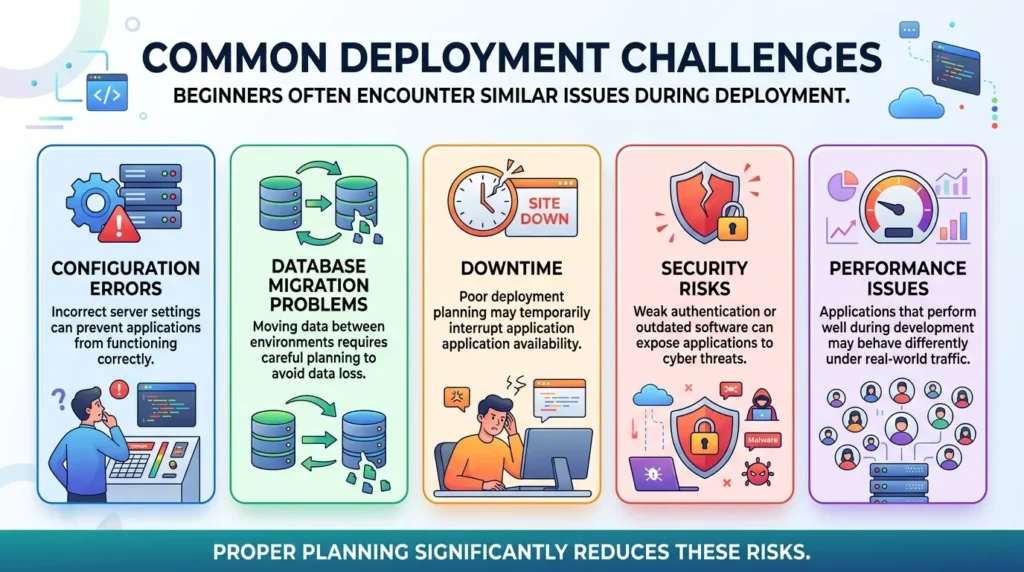
Common Deployment Challenges
Beginners often encounter similar issues during deployment.
Configuration Errors
Incorrect server settings can prevent applications from functioning correctly.
Database Migration Problems
Moving data between environments requires careful planning to avoid data loss.
Downtime
Poor deployment planning may temporarily interrupt application availability.
Security Risks
Weak authentication or outdated software can expose applications to cyber threats.
Performance Issues
Applications that perform well during development may behave differently under real-world traffic.
Proper planning significantly reduces these risks.
Best Practices for Successful Deployment
Following industry best practices improves deployment success.
Create a Deployment Checklist
A structured checklist ensures important tasks are not overlooked.
Automate Where Possible
Automation improves consistency and reduces manual errors.
Maintain Backups
Always back up application files and databases before deployment.
Test in a Staging Environment
A staging environment closely mirrors production and helps identify deployment issues before launch.
Monitor Continuously
Use monitoring tools to track application health after deployment.
Security Considerations During Deployment
Security is one of the most important aspects of custom application deployment.
Key recommendations include:
- Multi-factor authentication
- Secure API integrations
- Data encryption
- Role-based access control
- Regular vulnerability assessments
- Timely security updates
Security should remain an ongoing process rather than a one-time task.
Choosing the Right Development Partner
Deploying a custom application requires technical expertise across infrastructure, security, quality assurance, and ongoing maintenance.
When selecting a development company, consider:
- Industry experience
- Transparent communication
- Deployment expertise
- Post-launch support
- Security-focused development practices
- Scalability planning
An experienced development partner can help reduce deployment risks while preparing your application for future growth.
How Feynix Solution Supports Custom App Deployment
At Feynix Solution, we provide end-to-end custom app development services, from planning and development to deployment and post-launch support. Our expertise includes Android app development, iOS application development, enterprise and web applications, cloud deployment, performance optimization, security implementation, and application maintenance.
Whether you’re a startup or an established business, we build secure, scalable, and high-performing applications that support long-term business growth in Karachi, Pakistan, and beyond.
Customer Testimonials
Our deployment process was smooth, and the team explained every step clearly. The application launched successfully with minimal disruption to our operations.
— Business Owner, Karachi
The development team helped us understand deployment, security, and post-launch monitoring. We felt confident throughout the entire process.
— IT Manager
As a startup, we appreciated the structured deployment plan and ongoing support after launch. It made the transition much easier.
— Startup Founder
Frequently Asked Questions (FAQs)
What is custom app deployment?
Custom app deployment is the process of releasing a completed application to a live production environment where users can access it safely and reliably.
Why is deployment important in custom app development?
Deployment ensures your application is secure, stable, and optimized for real users while reducing the risk of downtime and technical issues.
How long does app deployment usually take?
As explained in this custom app development guide for beginners, deployment timelines vary depending on application complexity, infrastructure requirements, testing, and security reviews.
What are the biggest deployment challenges?
Common challenges include server configuration errors, database migration issues, security vulnerabilities, downtime, and performance optimization.
Should beginners hire a custom app development company?
Yes. Following a Custom app development guide for beginners is helpful, but working with an experienced development partner further reduces technical risks, ensures best practices are followed, and provides ongoing support after launch.
Conclusion
Successful deployment is a critical part of every software project. A well-planned deployment strategy improves security, application performance, scalability, and long-term reliability while minimizing risks during launch.
This Custom App Development Guide for Beginners provides a foundation for understanding deployment best practices. Whether you’re building your first business application or planning an enterprise solution, partnering with experienced professionals can make the deployment process smoother and more efficient.
If you’re looking for reliable custom app development, android app development, iOS application development, or custom mobile app development services for startups, Feynix Solution can help you build, deploy, and maintain scalable applications tailored to your business goals.
Author Bio
This article was prepared by the Feynix Solution content team, specializing in custom app development, enterprise software, mobile application development, web applications, and digital transformation solutions.
The team focuses on creating practical, business-oriented content that helps startups, business owners, and IT managers understand modern software development practices, deployment strategies, scalability, security, and emerging technologies.