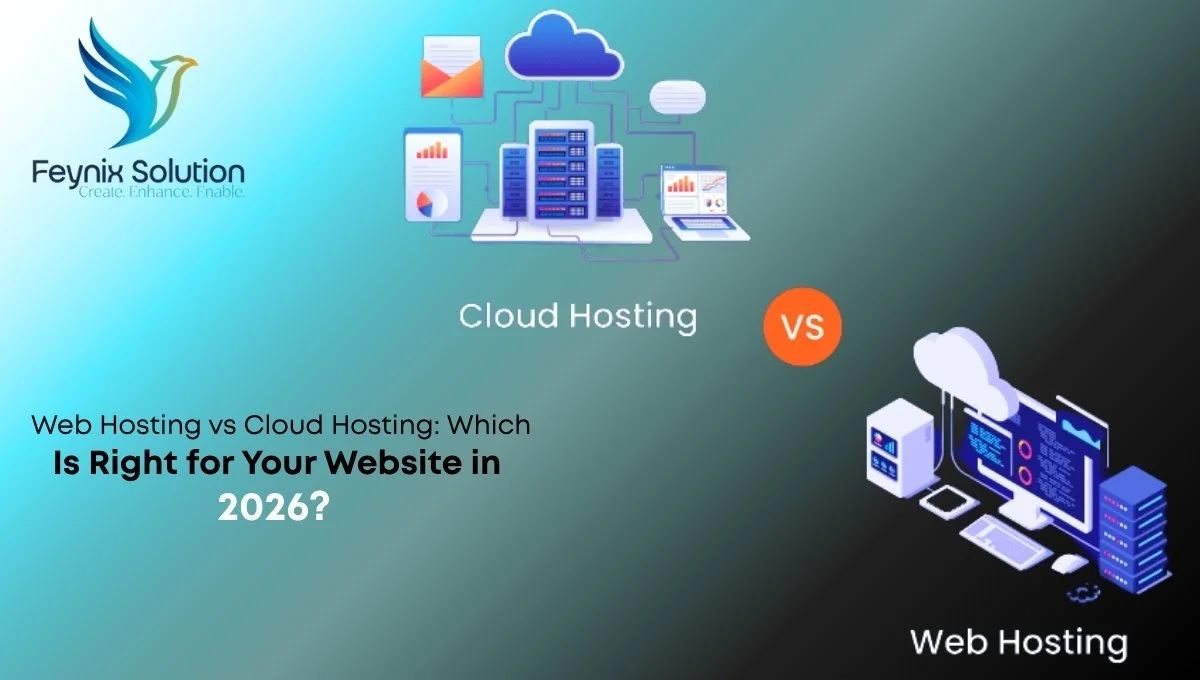
In today’s digital-first world, choosing the right hosting solution can directly impact your website’s performance, security, and long-term success. Whether you are launching a startup website, running an eCommerce store, or building a personal blog, the debate of Web Hosting vs Cloud Hosting has become more important than ever in 2026. Many businesses in the USA are now shifting their online infrastructure to more scalable and reliable solutions. However, understanding the difference between traditional web hosting and modern cloud hosting is essential before making a decision. In this guide, we’ll break it down in simple terms so you can choose the right option for your needs, with expert insight inspired by modern hosting practices offered by Feynix Solution.
What is Traditional Web Hosting?
Traditional web hosting encompasses shared hosting, virtual private servers (VPS), and dedicated servers. At its core, traditional hosting places your website files on a single physical machine inside a data center.

How It Works
- Shared Hosting: Multiple websites share the resources (CPU, RAM, and disk space) of one single server. This is the most affordable entry point for new sites.
- VPS Hosting: A single physical server is partitioned into isolated virtual environments. You still share the physical hardware, but you get a dedicated slice of resources.
- Dedicated Hosting: You rent an entire physical server exclusively for your website, giving you maximum control and power.
Because traditional hosting relies heavily on that single physical machine, it creates a solitary point of failure. If that specific server experiences a hardware malfunction or a power outage, your website goes down immediately, and for any business working with a Custom Web Development Company to build a performance-driven site, unexpected downtime can undo weeks of hard work and cost you real customers.
What is Cloud Hosting?
Cloud hosting completely completely reengineers the concept of server architecture. Instead of locking your website to one physical machine, cloud hosting distributes your data across an interconnected network of multiple physical and virtual servers.

How It Works
- Dynamic Resource Allocation: The hosting environment pulls processing power and memory instantly from a collective network cluster whenever a visitor lands on your website.
- Instant Automated Failover: If any single server in the network goes offline or experiences a hardware crash, a backup server immediately steps in to take over the workload.
- Uninterrupted Uptime: This continuous, built-in redundancy eliminates single points of failure, ensuring your website stays online without any service disruption.
Your hosting is only as good as the website running on it. If you need a site built the right way from the ground up, explore our Website Design and Development Services and let Feynix Solution handle the rest.
Head-to-Head Comparison: The Key Differences
To truly understand how web hosting vs cloud hosting impacts your daily operations, we must examine the core metrics that drive website performance and business growth.
| Feature | Traditional Web Hosting | Cloud Hosting |
| Infrastructure | Single physical server | Network of distributed virtual servers |
| Scalability | Rigid; requires manual plan upgrades | Instant and automated on-demand scaling |
| Uptime & Reliability | Higher risk of downtime from hardware failure | High availability due to built-in redundancy |
| Performance | Drops quickly under heavy traffic spikes | Smooth load balancing across the network |
| Pricing Model | Fixed monthly or annual subscription fees | Flexible, pay-as-you-go resource consumption |
Scalability and Performance
In the modern digital landscape, user experience is directly tied to server responsiveness. Over 53% of mobile visitors will abandon a webpage if it takes longer than 3 seconds to load. Traditional web hosting provides fixed resource allocations. If you experience an unexpected influx of traffic, perhaps from a successful marketing campaign or a viral social media post, your traditional server can run out of memory and crash. Upgrading usually requires selecting a higher-tier plan and waiting for system migrations. Cloud hosting handles traffic surges effortlessly through continuous load balancing. The network dynamically allocates extra CPU and RAM to absorb sudden traffic spikes, keeping your site fast and responsive when you need it most. Once the traffic subsides, the system automatically scales down your resources.
Security and Reliability Imperatives
Cybersecurity threats continue to grow more sophisticated every day. Security is a non-negotiable component of infrastructure management. Traditional web hosting secures your data at the physical hardware level. If you are on a shared hosting plan, you face the “noisy neighbor” phenomenon. If a neighboring site on your server gets targeted by a massive DDoS attack or suffers a malware infection, your site’s performance and security could be compromised. Cloud hosting relies on network-level security with extensive redundancy. Isolating websites within virtual environments prevents cross-site contamination. Built-in, automated data mirroring ensures that real-time copies of your website exist across different physical locations, making disaster recovery swift and seamless.
Financial Breakdown: Upfront Costs vs. Long-Term Value
Budgeting for your digital infrastructure requires analyzing both immediate costs and long-term return on investment (ROI).
- Traditional Web Hosting Costs: This option remains highly attractive for startups and small portfolios due to low upfront costs. Shared plans typically range from $2 to $10 per month. However, these fixed costs can become inefficient if you pay for resources your site rarely uses during low-traffic periods.
- Cloud Hosting Costs: Cloud hosting generally starts at a higher baseline, often ranging from $15 to over $200 per month depending on your configuration. However, it offers a pay-as-you-go model. You only pay for the exact bandwidth, processing power, and storage you consume, which provides massive cost efficiency for fluctuating business models and scaling applications.
Want to go deeper? Before you finalize your hosting plan, make sure you choose the right type of website for your business. Check out our detailed guide on Website Builder vs Custom Website, it covers everything you need to know to make a confident decision.
Which One is Right for Your Website?
The choice between web hosting vs cloud hosting ultimately depends on your specific business use case, technical expertise, and growth projections.
Choose Traditional Web Hosting If:
- You are launching a new personal blog, a local business portfolio, or a small informational website.
- Your monthly traffic is highly predictable and rarely fluctuates.
- You operate on a tight startup budget and want simple, fixed monthly expenses.
- You prefer straightforward cPanel management without a steep technical learning curve.
Choose cloud hosting if:
- You run a fast-growing eCommerce store or a software-as-a-service (SaaS) application.
- Your website experiences frequent, unpredictable traffic spikes or seasonal sales events.
- You manage database-intensive operations that require fast server-side caching and low latency.
- High availability and near-zero downtime are absolutely critical to your business revenue.
The 2026 Reality — Why More Businesses Worldwide Are Moving to Cloud

The global hosting landscape has shifted dramatically. In 2026, Google’s Core Web Vitals make page speed a direct ranking factor on a global scale. International consumers expect websites to load in under two seconds, and they leave if they do not. Businesses worldwide that run on slow shared hosting lose visitors, rankings, and revenue every single day.
Cloud hosting gives you the foundation to compete globally through five key advantages:
- Global Page Speed Optimization: Cloud infrastructure utilizes distributed networks to serve content from the server closest to your international visitors, keeping load times under the critical two-second threshold.
- Modern Tech Stack Integration: It effortlessly supports advanced frameworks, containerization (like Docker), and continuous integration pipelines that modern development teams require.
- AI-Powered Tool Compatibility: Cloud environments provide the raw processing power and flexible architecture needed to run real-time AI tools and personalized customer experiences.
- High Availability and Resilience: By eliminating single points of failure, cloud hosting ensures your business stays online across different time zones, protecting your global revenue strategy.
- Seamless Resource Scaling: You can instantly scale your infrastructure up or down based on worldwide traffic spikes without experiencing server crashes or performance drops.
Choosing the right hosting is just one piece of the puzzle. The technology behind your website matters just as much, and if you want to see how cutting-edge web solutions can give your business a real edge, explore our full breakdown of the Benefits of Progressive Web Apps for Business.
Future-Proofing Your Digital Infrastructure
Building a beautiful website means very little if your underlying server environment cannot support your visitors. Managing complex server architectures, setting up server-side caching, and choosing the perfect hosting framework requires specialized digital expertise. When you need to bridge the gap between advanced code and flawless deployment, partnering with an expert development agency makes all the difference. Feynix Solution specializes in building high-impact, custom web applications and scalable e-commerce platforms engineered from the ground up for speed, security, and top-tier performance.
Instead of treating hosting like an afterthought, the expert team at Feynix Solution aligns your web development with future-proof infrastructure, ensuring your digital platform scales smoothly alongside your business. Turn your website into a powerful business tool by making the right foundational choice today.
How Feynix Solution Helps You Build Better Websites
When it comes to reliable hosting and digital infrastructure, Feynix Solution stands out as a trusted name for businesses looking to grow online. Feynix Solution focuses on delivering modern hosting services that match the needs of today’s fast-paced digital world. Whether a business needs traditional web hosting or scalable cloud hosting solutions, Feynix Solution ensures stability, performance, and support.
What Makes Feynix Solution Valuable:
- Reliable and secure hosting infrastructure
- Performance-focused server optimization
- Scalable hosting options for growing businesses
- Support tailored for business needs
- Solutions designed for modern web demands
By focusing on efficiency and reliability, Feynix Solution helps businesses reduce downtime and improve website performance.
Customer Reviews
⭐ Marcus T. – New York, USA
I switched my business website from traditional hosting to cloud hosting and immediately noticed faster loading speeds and better uptime. It made a real difference in customer experience.
⭐ Jennifer Cardwell – California, USA
I was confused between web hosting vs cloud hosting, but after upgrading, my online store runs much smoother. I’ve had fewer crashes during high traffic periods.
⭐ Michael Brown – Texas, USA
The scalability of cloud hosting helped my startup grow without worrying about server limits. Everything feels more stable and professional now.
⭐ Darek S. – Florida, USA
My website performance improved a lot after moving to cloud hosting. Pages load quickly, and I don’t face downtime issues anymore, even during peak hours.
⭐ Brian Hoffmann – Illinois, USA
I started with basic web hosting, but as my traffic increased, I switched to cloud hosting. It was the right decision for long-term growth and reliability.
People Also Ask (PAA)
1. What is the main difference between Web Hosting and Cloud Hosting?
Web Hosting stores your website on a single server, while Cloud Hosting uses multiple connected servers. This means cloud hosting offers better speed, uptime, and scalability compared to traditional web hosting.
2. Is Cloud Hosting more expensive than Web Hosting?
Cloud Hosting can cost more depending on usage, but it provides better value because you only pay for the resources you use. Web Hosting is usually cheaper upfront but offers limited flexibility.
3. Which hosting is better for a business website in 2026?
For most growing businesses in 2026, Cloud Hosting works better because it handles traffic spikes, improves performance, and reduces downtime risks. Web Hosting is suitable for small or starter websites.
4. Can I upgrade from Web Hosting to Cloud Hosting later?
Yes, most hosting providers allow easy migration from web hosting to cloud hosting. This helps you start small and scale your website as your traffic and business grow.
5. Does Cloud Hosting improve website speed?
Yes, Cloud Hosting improves website speed because it distributes data across multiple servers and reduces load on a single machine, resulting in faster page loading times.